


 Cart
Cart
 sales@molnova.com


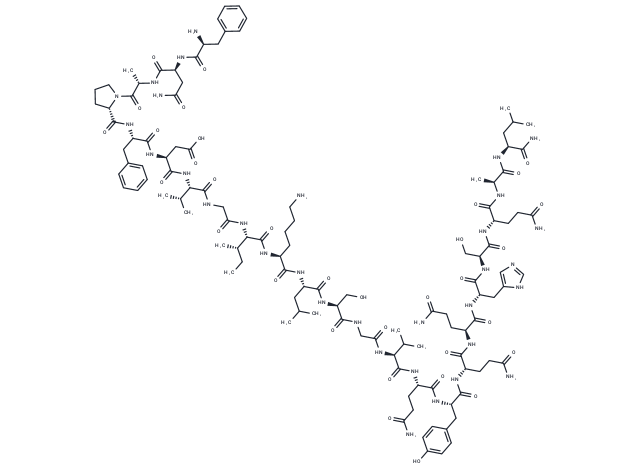
Obestatin (human)
CAS No. 1081110-72-6
Obestatin (human)( —— )
Catalog No. M35043 CAS No. 1081110-72-6
Obestatin (human) is an endogenous ligand for G-protein eurythmic entity 39 formed by shearing of preproghrelin, which inhibits feeding in a dose-dependent manner, and can be used in the study of obesity.
Purity : >98% (HPLC)
 COA
Datasheet
HNMR
HPLC
MSDS
Handing Instructions
COA
Datasheet
HNMR
HPLC
MSDS
Handing Instructions
| Size | Price / USD | Stock | Quantity |
| 2MG | 196 | Get Quote |


|
| 5MG | 376 | Get Quote |
|
| 10MG | 566 | Get Quote |
|
| 25MG | 858 | Get Quote |
|
| 50MG | 1150 | Get Quote |
|
| 100MG | 1521 | Get Quote |
|
| 500MG | Get Quote | Get Quote |
|
| 1G | Get Quote | Get Quote |
|
Biological Information
-
Product NameObestatin (human)
-
NoteResearch use only, not for human use.
-
Brief DescriptionObestatin (human) is an endogenous ligand for G-protein eurythmic entity 39 formed by shearing of preproghrelin, which inhibits feeding in a dose-dependent manner, and can be used in the study of obesity.
-
DescriptionObestatin(human) is a 23-amino acid amidated peptide that regulates appetite and gastrointestinal motility via its interaction with GPR39. Obestatin(human) can be used for weight loss. Obestatin(human) cannot penetrate the cell membrane.
-
In VitroThe primary structure of Obestatin(human) indicates that it only presented one lysine at position 10, which suggests that it cannot penetrate the cell membrane.
-
In VivoIn adult male mice, intraperitoneal injection of Obestatin(human) suppresses food intake in a timeand dose-dependent manner.
-
Synonyms——
-
PathwayOthers
-
TargetOther Targets
-
RecptorOthers
-
Research Area——
-
Indication——
Chemical Information
-
CAS Number1081110-72-6
-
Formula Weight2546.83
-
Molecular FormulaC116H176N32O33
-
Purity>98% (HPLC)
-
SolubilityIn Vitro:?DMSO : 1.96 mg/mL (0.77 mM; ultrasonic and adjust pH to 5 with HCl )
-
SMILESC(N[C@@H](CC1=CC=CC=C1)C(N[C@H](C(N[C@H](C(NCC(N[C@H](C(N[C@H](C(N[C@H](C(N[C@H](C(NCC(N[C@H](C(N[C@H](C(N[C@@H](CC2=CC=C(O)C=C2)C(N[C@H](C(N[C@H](C(N[C@@H](CC3=CN=CN3)C(N[C@H](C(N[C@H](C(N[C@H](C(N[C@@H](CC(C)C)C(N)=O)=O)C)=O)CCC(N)=O)=O)CO)=O)=O)CCC(N)=O)=O)CCC(N)=O)=O)=O)CCC(N)=O)=O)C(C)C)=O)=O)CO)=O)CC(C)C)=O)CCCCN)=O)[C@H](CC)C)=O)=O)[C@@H](C)C)=O)CC(O)=O)=O)(=O)[C@H]4N(C([C@@H](NC([C@@H](NC([C@H](CC5=CC=CC=C5)N)=O)CC(N)=O)=O)C)=O)CCC4
-
Chemical Name——
Shipping & Storage Information
-
Storage(-20℃)
-
ShippingWith Ice Pack
-
Stability≥ 2 years
Reference
1. Guangcai Ren, et al. Effect of TAT-obestatin on proliferation, differentiation, apoptosis and lipolysis in 3T3-L1 preadipocytes. J Pept Sci. 2013 Nov;19(11):684-91.?
molnova catalog



related products
-
Ethaselen
Ethaselen (BBSKE) is an orally active and selective thioredoxin reductase 1 (TrxR) inhibitor with anticancer activity that directly inhibits TrxR1 activity and is commonly used in combination with oxaliplatin to inhibit tumor growth.
-
Ethylmalonic acid
Ethylmalonic acid can be found in blood cerebrospinal fluid (CSF) and urine as well as in human fibroblasts prostate and skeletal muscle tissues. Moreover ethylmalonic acid is found to be associated with anorexia nervosa and malonyl-CoA decarboxylase deficiency. Ethylmalonic acid is a non-carcinogenic potentially toxic compound.
-
DL-Arginine
DL-Arginine is used in analysis of amino acid complexation dynamics and crystal structure formations.
